
Case Study: Sharing Excess
We don't just make videos. We build tools that solve your business's hardest communications problems.
That starts with your business, not a camera. We learn what you do, who you're trying to reach, and where your story isn't landing — the bottlenecks. Then we target the right audience with the right story to drive the outcome you need.
When Sharing Excess came to us, they'd already done the hard part. They'd built a real food rescue operation and made a genuine impact in their community — they just didn't have a practical and emotionally engaging way to tell that story. That gap was the bottleneck.
First, we introduced them to the world
We needed to earn trust with the broadest possible audience: anyone encountering Sharing Excess for the first time. Trust like that doesn't come from a mission statement — it comes from knowing a founder's story, understanding how something actually works, and seeing its impact firsthand. So we built a film that did all three: opening with the founder's story, showing how Sharing Excess actually operates, and letting the scale of its impact speak for itself.
Then we made the case for a second location.
This was the video that mattered most.
Sharing Excess's bottleneck was no longer awareness — it was scale. One location taking donations meant growth needed someone new to say yes.
On the surface, this video celebrates a milestone: Sharing Excess giving away more than 10 million pounds of food.
In reality, it's a declaration of Sharing Excess's ability to create real financial impact, aimed at the one audience with the power to grant a second location: the general manager of another major wholesale produce market, and the food producers inside it who could become new donors. This audience wasn't wondering whether food waste was a problem — they were deciding whether Sharing Excess could solve it at their scale.
Instead of telling this story in Sharing Excess's voice, the video is told by people the audience already trusted — wholesalers who'd seen the operation work, and the GM of the current location.
And it worked. Sharing Excess secured a second location, and with it, a much bigger reach.
Then we went looking for volunteers
Sharing Excess's next bottleneck was volunteers. The organization runs on them, and needed more.
Before someone gives up a Saturday, they're not just asking whether the cause matters. They're asking who they'd be doing it with, and whether their time actually helps anyone. So instead of Sharing Excess making the case, we let the volunteers already showing up make it — working side by side, seeing the impact land in real time, and explaining why they keep coming back.
What the video introduces isn't just a cause people can support. It's a culture of people already showing up for it — and proof that showing up actually helps.
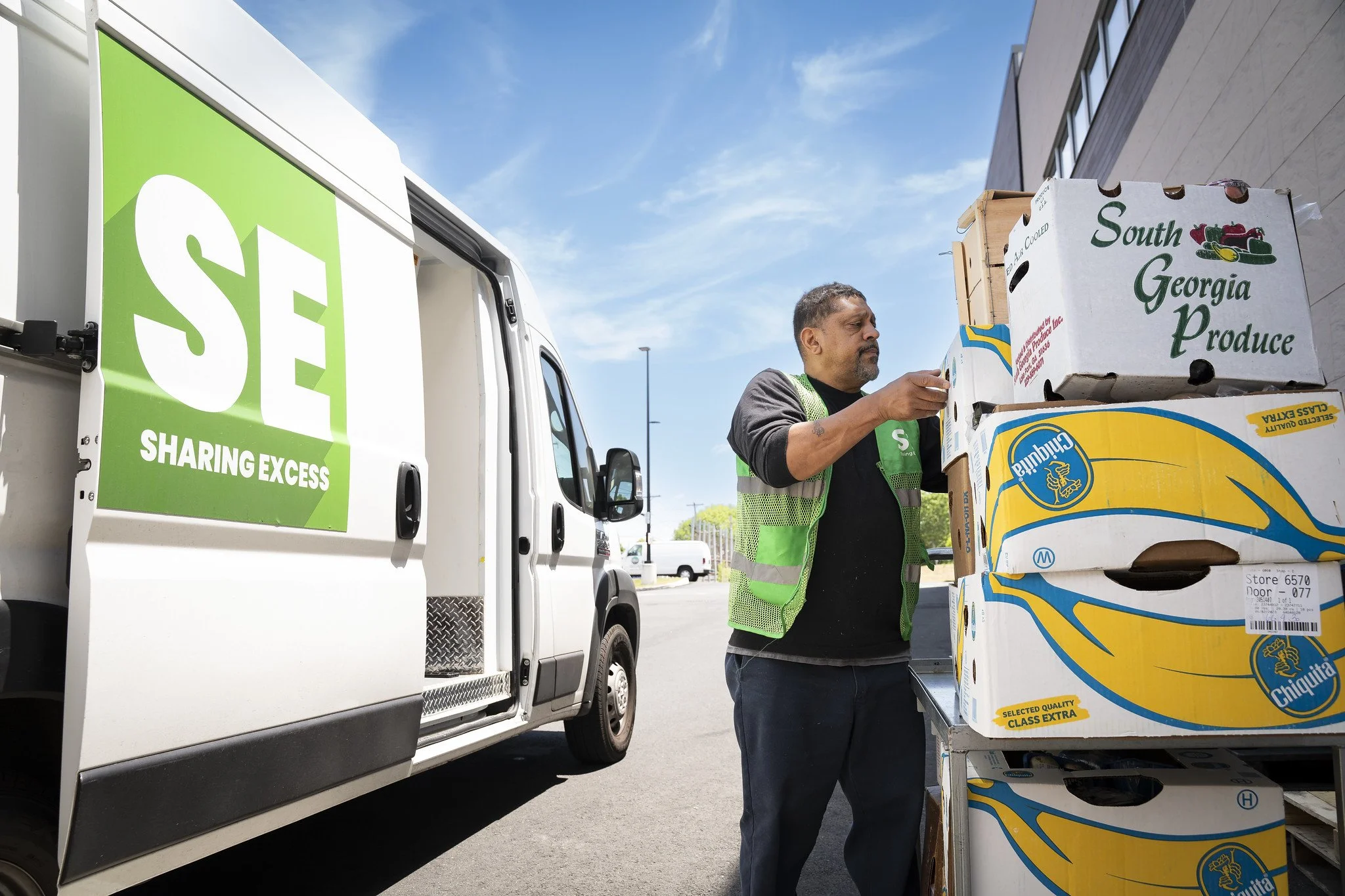
Alongside the films, we also built Sharing Excess a body of photography — images that gave them material to use across their own communications, well beyond the videos themselves.
If your organization has a similar bottleneck — a story you haven't identified, don't know how to tell, or an audience you're not reaching — let's find that problem and fix it, together.